
I keep seeing some version of the same warning:
If you use AI to write, eventually you won’t be able to write anymore.
Your writing skills will decline. Your critical-thinking skills will deteriorate. Your brain will basically turn to mush because ChatGPT is doing everything for you.
And I keep thinking…
Okay.
Maybe a little?
I’m actually not willing to dismiss the concern completely, because there IS a legitimate point buried underneath all the doomsday language.
Yes, AI can weaken skills you stop practicing
If I stop practicing a skill, I’m probably going to get worse at it. That’s not an AI thing. That’s a human thing.
If I use a calculator for every calculation I encounter, I’m probably not going to be as fast at mental arithmetic as someone who practices it constantly.
If I use GPS everywhere I go, I’m probably going to develop less of an internal map of the places I drive through.
And if I never write anything from a blank page because AI always produces the first draft for me, then yes, I may get less practiced at producing a polished piece of writing entirely on my own.
Fair enough.
There is even some early research that gives us reason to take the concern seriously.
In a 2025 MIT Media Lab study of essay writing, participants were assigned to use an LLM, a search engine, or no external tools. EEG measurements showed different patterns of brain connectivity between the groups, with the LLM group showing the weakest connectivity during the task. The LLM group also reported less ownership of their essays and had more difficulty accurately quoting what they’d written. MIT Media Lab
But there are some pretty important limits to what we can conclude from that.
It was a specific essay-writing experiment. Fifty-four people participated in the first three sessions, and 18 completed a fourth. And the paper was published as an arXiv preprint, rather than evidence that ordinary AI use causes generalized cognitive decline. MIT Media Lab
So no, I don’t think the concern is made up. I just think the conclusion people are drawing from it is much too big.
Skill decay isn’t the same thing as cognitive decline
The question isn’t simply:
Did I use AI?
The better question is:
What thinking did I hand over to AI, and what am I doing with the capacity I got back?
Those are not the same thing. And this is where a lot of the conversation about AI goes sideways.
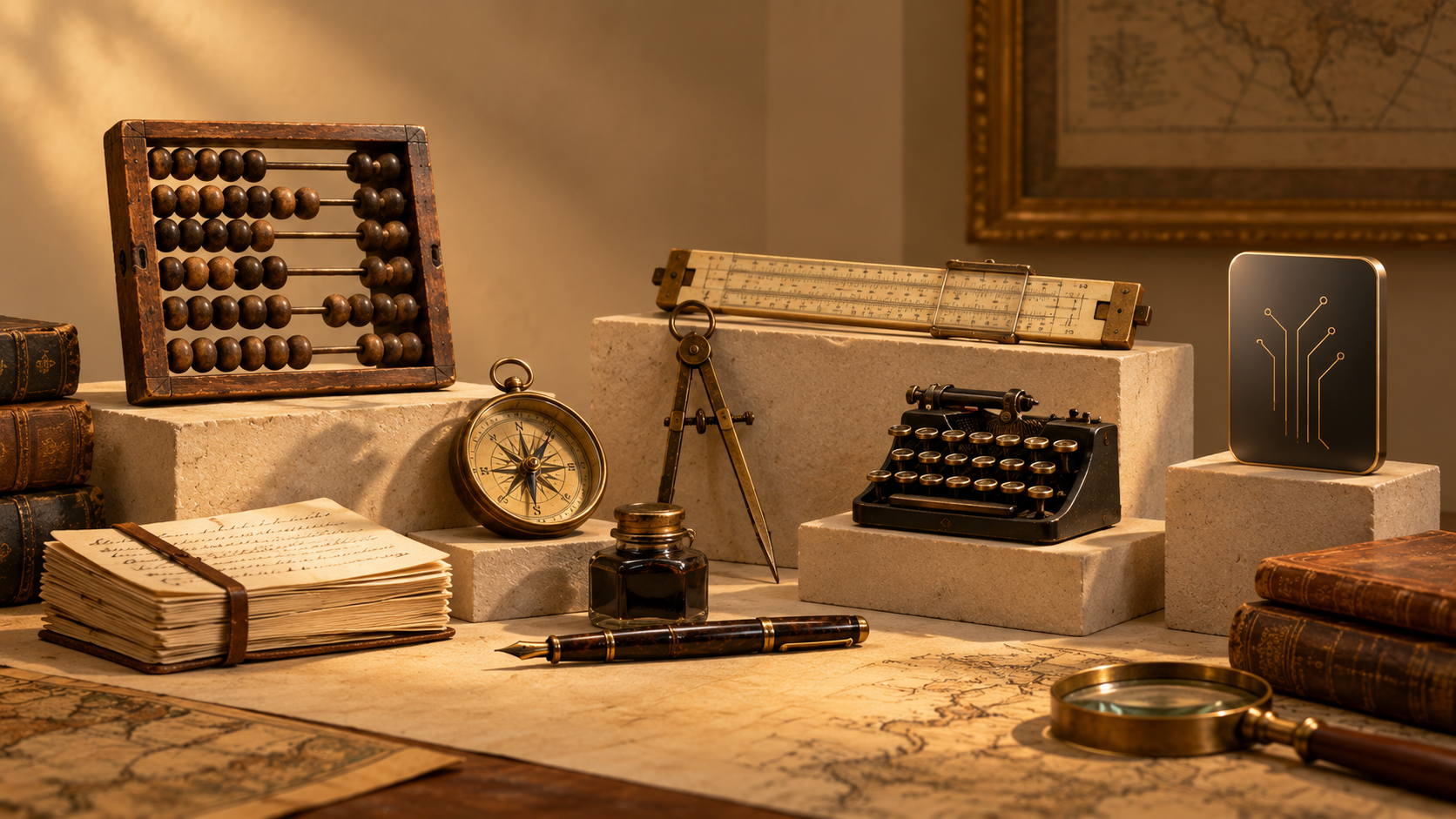
Human beings have been handing pieces of cognitive work to tools for a very, very long time.
I have no idea whether somebody stood around in ancient Mesopotamia screaming that the abacus was going to destroy civilization, so I’m not going to invent that story. But I’m willing to bet it had its detractors.
Calculators absolutely reduced the amount of arithmetic most of us do by hand, or in our head.
Typewriters were the death of handwriting. Ask me how I know.
Spellcheck means I don’t have to stop and look up every word I’m unsure about.
Search engines mean I don’t memorize as many facts as I would have needed to, decades ago.
Phone books, and then mobile phones, reduced the need for us to remember phone numbers, to the point where some people don’t even remember their own phone number.
Computers, of course, replaced piles of tasks people once performed manually.And yes. Some of the old skills get weaker.
But we don’t normally measure technological progress by asking whether humans remain equally proficient at every task the technology was invented to make easier.
That’s a very strange standard.
I use a calculator all the time. I can still add.
I type almost everything. I can still write with a pen.
My handwriting is considerably uglier than it probably would be if I handwrote six hours a day, but I’m finding it difficult to summon the appropriate level of alarm about that.
AI feels similar to me.
What thinking are you actually handing over?
Before AI, I had a million ideas. That part is not new. The problem was that every one of those ideas showed up dragging 47 additional jobs behind it.
Research it. Organize it. Outline it. Write the first draft. Rewrite the first draft. Edit the rewrite. Turn it into a presentation. Make social media posts. Come up with titles. Figure out what I forgot.
And if I wanted to actually TALK through an idea before doing any of that, I needed another human being willing to sit there while I said, “Okay, so hear me out…” for the next 45 minutes.
That’s a pretty significant bottleneck when your brain produces ideas faster than you can possibly execute them.
Now I can say:
“I’ve been thinking about something. I think X is happening because of Y, but I’m not sure whether I’m overlooking something. Push back on this.”
And then I push back on the pushback. I change my mind. Or I don’t.
I ask for another angle. I reject half of it. Something it says triggers another idea I hadn’t considered.
Twenty minutes later, the thing that had been bouncing around vaguely in my head has structure.
Did AI participate in that?
Obviously.
Did I stop thinking?
No.
In many cases, I’m thinking about the idea more than I ever would have before, because previously it would have joined the other 9,000 ideas in the giant imaginary warehouse in my head labeled SOMEDAY.

The 9,000 Ideas Warehouse: Same brain. More help getting the ideas off the shelf.
Interestingly, research with knowledge workers suggests that this shift in where the thinking happens is real. A 2025 CHI study surveyed 319 professionals and collected 936 examples of people using generative AI in their work. Participants described critical thinking moving toward things like checking information, integrating AI responses, setting goals, and supervising the work. The study also found an important warning: higher confidence in the AI was associated with less critical thinking, while higher confidence in one’s own ability was associated with more critical thinking. Microsoft
That makes sense to me. Because there is absolutely a lazy way to use AI.
“Write this for me.”
Copy.
Paste.
Post.
Never question anything. Never check anything. Don’t even read it particularly carefully.
Yeah. Do that long enough and I can absolutely believe you’re exercising fewer of the skills involved in writing and thinking.
But that’s a way of using AI. It isn’t an unavoidable property of AI.
Sometimes struggling through the work IS the point
I can use AI to organize an argument without surrendering the argument.
I can let it produce a draft and still decide what’s true, what’s weak, what’s missing, what sounds nothing like me, and what needs to be thrown out completely.
I can ask it to challenge my reasoning instead of just agreeing with me.
And I can deliberately do the work myself when the skill itself is what I’m trying to develop.
That’s an important distinction.
If I were trying to become a novelist, I would not have AI write all my prose and then congratulate myself on becoming a better novelist.
If I were learning algebra, I’d probably want to understand the algebra before outsourcing every calculation.
If I’m working in an area where I know so little that I can’t recognize a completely bogus answer, that’s a problem too.
Sometimes struggling through the work IS the point. But sometimes it isn’t. And I think we need to get much better at telling the difference.
Nobody expects the entrepreneur to do every job
There’s another comparison I almost never see in these conversations.
Entrepreneurs.
Imagine someone builds a company.
She comes up with an idea for a new product.
She talks it through with her leadership team.
Researchers investigate the market.
A writer creates the copy.
A designer makes the graphics.
A video team produces the launch video.
The social team turns it into 15 pieces of content.
Nobody runs into the room yelling:
“WAIT. Did YOU personally write paragraph four of the landing page?”
Of course not.
We understand that her intellectual contribution isn’t measured by whether she personally performed every production task required to turn the idea into reality.
She decides what they’re building.
Why they’re building it.
Who it’s for.
What good looks like.
What needs to change.
What gets approved.
What gets killed.
Where they go next.
We call that leadership.
But give one person access to AI that allows them to perform a surprising amount of that same delegation without employing an entire staff, and suddenly we’re worried that they aren’t doing enough of the “real work.”
Why?
Why does physically typing every sentence qualify as thinking, while deciding what the sentence needs to say somehow doesn’t?
I don’t buy that distinction. And I’m saying that as someone who genuinely likes writing.
I’m not trying to become incapable of writing without AI. I don’t WANT to lose that ability.
But I also don’t need to prove my intellectual worth by manually performing every step of every project for the rest of my life.
Cognitive offloading is not new
Psychologists have a term for using something outside ourselves to reduce the amount we have to remember or process internally: cognitive offloading.
A shopping list is cognitive offloading.
So is a calendar.
So is writing something down instead of keeping it in your head.
A 2025 review in Nature Reviews Psychology looked at research on this kind of offloading and found exactly the kind of tradeoff you might expect. External aids can improve performance on the task we’re doing, but there can also be a cost if we later lose access to the information we’ve offloaded. Nature
That doesn’t strike me as an argument to stop using external tools. It strikes me as an argument to understand what the tool is doing for us.
I care a lot less about whether I’m personally carrying every piece of information around in my head than I do about whether I’m still exercising judgment.
Am I questioning things?
Am I learning?
Am I making connections?
Am I catching errors?
Am I deciding what I believe instead of asking a machine what I should believe?
Am I creating things I actually care about?
That’s where I want my brain involved.
The better question: What should we offload?
So maybe the useful conversation isn’t:
Will AI make us stupid?
That’s too crude to tell us much.
I’d rather ask:
What should I continue doing with my own brain, what can I safely hand off, and what higher-value thinking becomes possible because I handed it off?
And I don’t think the answer will be identical for everyone.
Someone learning to write needs a different relationship with AI than someone who has been writing professionally for 20 years.
Someone studying a subject needs a different relationship with it than someone trying to turn a well-developed idea into six different formats before Friday.
And someone who blindly accepts whatever an AI produces is doing something very different from someone who uses it to question, compare, critique, revise, and explore.
Those distinctions matter.
Because my experience with AI so far hasn’t been:
“Thank God, now I don’t have to think.”
It’s been almost the opposite.
I can finally DO something with more of what I’m thinking about. I used to have millions of ideas and almost none of them got started.
Now I have millions of ideas and I start all of them. Which has created an entirely different problem, because I don’t finish all of them.
I’m still working on that.
Apparently AI has not solved everything yet.
Sources referenced
- MIT Media Lab, Your Brain on ChatGPT: Accumulation of Cognitive Debt when Using an AI Assistant for Essay Writing Task (2025). MIT Media Lab study
- Lee et al., The Impact of Generative AI on Critical Thinking, CHI 2025. Microsoft Research / CHI paper
- Richmond & Taylor, The benefits and potential costs of cognitive offloading for retrospective information, Nature Reviews Psychology (2025). Nature Reviews Psychology review